Starting with the Requirements for Chinese Text Layout
Editor’s note: The first draft of the W3C Editor’s Draft Requirements for Chinese Text Layout was published on 28 March. It sets out the requirements of Chinese text layout and is a useful reference for developers of layout engines and practitioners in digital publishing. The draft was compiled by the W3C group at Beihang University together with several invited experts, including the Taiwanese digital publisher and Web and EPUB standards advocate Bobby Tung; the Web developer and author of Han.css, Ethan Chen; type and lettering enthusiast and The Type contributor Liang Hai; and another The Type contributor, the language and typography researcher Eric Liu.
This article, written by Bobby Tung, tells the story of how the document came about and the background to its drafting. We also recommend the podcast IT Gonglun’s interview with Bobby Tung.
The W3C recently published the first Editor’s Draft of “Requirements for Chinese Text Layout”. It is the first milestone of my work in digital publishing. I have only been involved with W3C for three years—a short time, but I arrived just as the wave was rising: text layout, font technology and the implementation of the world’s languages on the Web and in EPUB are all accelerating along with digital publishing.
The origins of the Chinese layout requirements
The first complete language specification from the W3C i18n group (internationalisation—abbreviated i18n because there are 18 letters between the i and the n) was the “Requirements for Japanese Text Layout” (JLReq). The document took five years to write and was published in 2008. The information it provides on Japanese typesetting greatly advanced the implementation of CJK layout on the Web, especially vertical text.
Because JLReq was so influential, i18n gradually began organising task forces to publish layout requirements for other languages. There are now KLReq (Korean text layout requirements), Indic Layout Req (Indic layout requirements), and even for Western text, which we might think poses no problems at all, there are the Requirements for Latin Text Layout and Pagination. Chinese, of course, would not lag behind.
It was first raised by Ping Ye of Google Taiwan in the Chinese HTML5 interest group: could we also write a Chinese layout requirements document? He then raised a number of issues one after another, such as hanging punctuation and line-start prohibition rules… These are recorded in the group’s early Wiki ; Chinese typesetting experts such as Lao Mao of Owl Publishing also took part. But the effort could not be sustained, and the topic sank.
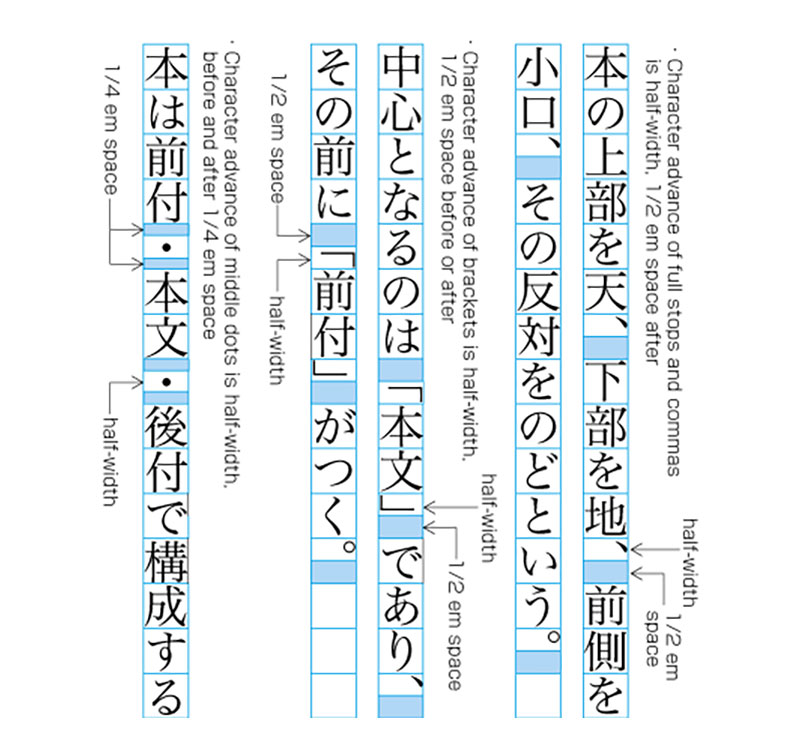
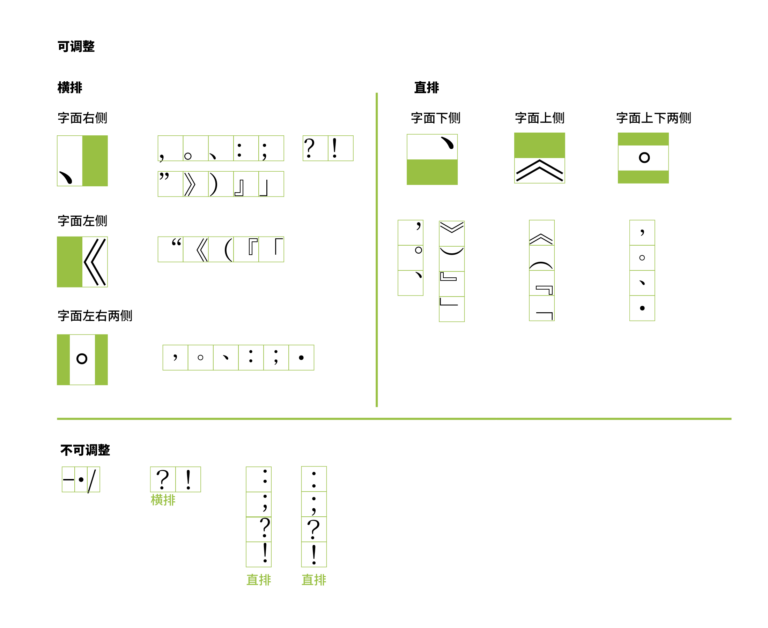
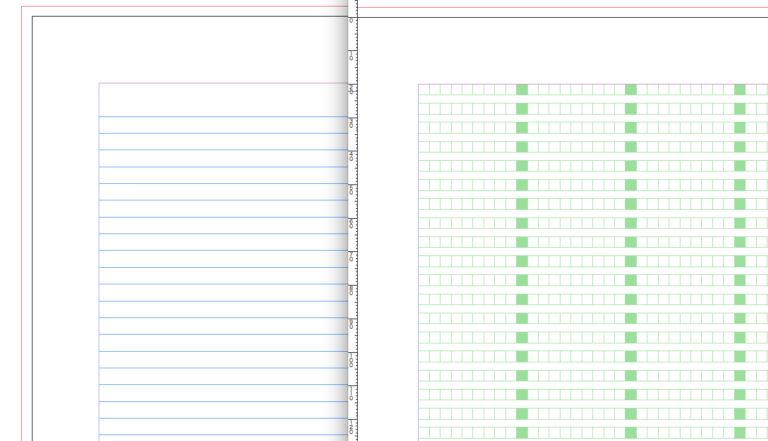
W3C “Requirements for Japanese Text Layout” (JLReq) detail illustration
Zhuyin as the starting point
After the EPUB 3 standard was completed in 2011, I kept trying to work out how to make good Chinese books that respect tradition. My new start-up also joined the IDPF and took part in the detailed revision of EPUB 3.0.1, which aimed to make EPUB an ISO standard. During the revision, discussion of how to implement zhuyin (bopomofo) in EPUB revealed that this was not something the EPUB format should handle; it had to go back to W3C and be done through HTML5 and CSS.
Just then W3C and IDPF began working together, and to establish the W3C Digital Publishing Interest Group they held workshops in New York, Paris and Tokyo to gather input and define the group’s purpose. I made it to the Tokyo workshop on internationalisation requirements, and so began my days at W3C.
Once involved, I could see how energetically Japan pushes the implementation of language standards, from W3C to the Unicode Consortium, and with the completeness of JLReq , progress was very fast. But Japanese is not Chinese after all, and many differences between the languages kept emerging; filling in all of Chinese’s requirements was beyond my power alone. So I remembered Ping Ye’s early proposal and tried to write the “Requirements for Chinese Text Layout.”
There is a famous saying in programming circles: “Don’t reinvent the wheel.”
Writing requirements and specifications is the same: “Don’t start from zero.”
So I spent a few months working first on JLReq , quickly translating most of it into Chinese to understand its structure, then wrote a first draft of a specification for Traditional Chinese layout following its rules. But once it was finished, W3C membership fees were high and few people cared about typesetting, so it could only sit there. Fortunately the 2013 W3C annual meeting was held in Shenzhen, where I discussed it with Professor Hu Chunming, An Qi and Xiaoqian of the Beihang W3C office, and we agreed to add Simplified Chinese layout rules and write a “Requirements for Chinese Text Layout.”
The wisdom of our ancestors, always passed on by word of mouth
For a new start-up that hasn’t made any money yet, throwing itself into standardisation work is practically suicidal. When I knocked on doors looking for funding, what I often heard was: “Why does Chinese typesetting need rules?” For a moment I had no answer. So I began to explore how JLReq came to be.
In the era of movable type, both Japanese and Chinese had a body of typesetting craft passed orally from master to apprentice. In the phototypesetting era, the technology exported by Shaken influenced the whole sinosphere. As long as composition remained physical, these skills could still be passed on and applied. But with the move to desktop publishing, a huge barrier arose.
The developers of desktop publishing software from the West, such as PageMaker and QuarkXPress, naturally did not know how Eastern scripts should be set, nor could they comprehensively learn these orally transmitted crafts. Japan organised these typesetting practices into documents, publishing the Japanese Industrial Standard JIS X 4051, “Formatting rules for Japanese documents,” in 1993, so that this software could understand Japanese layout and implement it in its features. To this day, traces of Japanese layout can be seen in Adobe InDesign’s CJK and punctuation features.
JLReq drew heavily on, rewrote and expanded the JIS X 4051 standard. If JIS X 4051 helped printing make the transition from analogue to digital, then JLReq carried it from print to the Web and to EPUB ebooks built on Web technology, so that Japanese typesetting technique could be handed down in an unbroken line. These documents and rules have also given rise to all kinds of editorial guides and typesetting textbooks, keeping the quality of Japanese layout high.
What the Chinese layout requirements aim to supply is exactly this stretch of history and craft, and we hope to influence the whole environment and raise the quality of Chinese layout on the Web and in ebooks.
East wind, west wind: blowing in confusion
In recent years mainland China, Taiwan and Hong Kong have begun to value design, and type design and typesetting technology are receiving renewed attention. But there is little reference material in Chinese; thirsty for knowledge, people can only look to the West and Japan. Because of linguistic and cultural differences, however, what they find often cannot be applied directly.
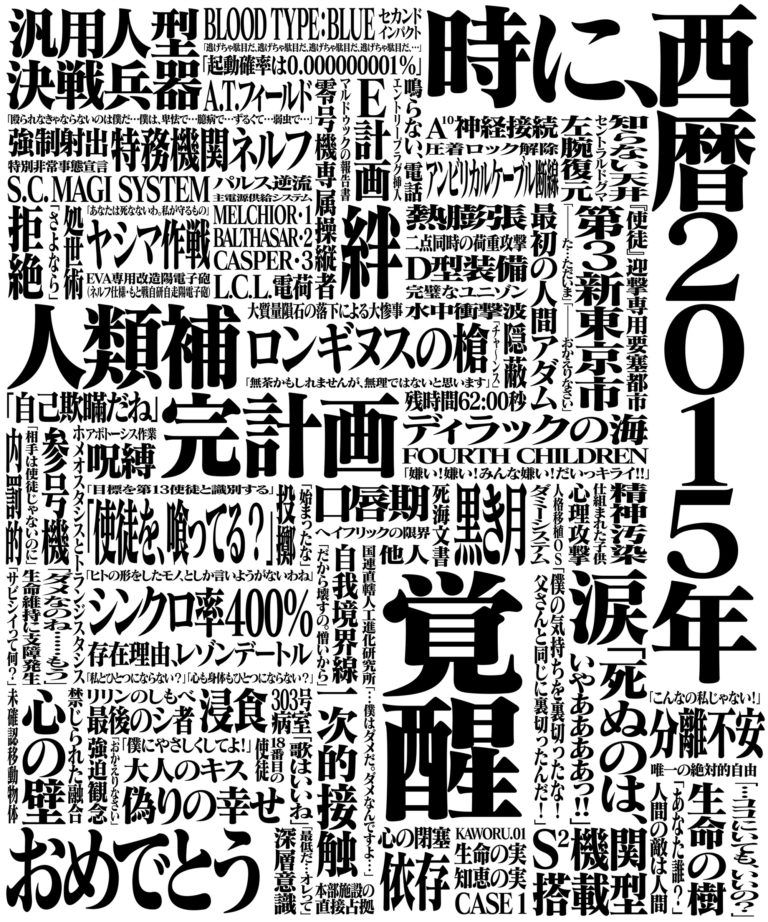
Take kerning in Western type, known in Japan as “tsume”: it reduces the space between letters to make them look better. Applied to Chinese, though, it looks odd. Square Chinese characters have always been set one after another, with no added space and certainly no reduction (you can hardly take a file to the metal type). So at most it applies to graphic design and headlines, not to body text.
Graphic design and editorial design are not the same. Graphic design can be free and unconstrained, but editorial design must begin by learning the rules, never forgetting the basic fact that content is there to be read.
The Chinese layout requirements try to identify the traditions and particularities of Chinese layout—not to become shackles forced onto designers. Shin Sobue, a student of Kohei Sugiura and a master of Japanese book design, is famous for breaking the rules, but his work too is built on knowing the norms well and then going beyond them.
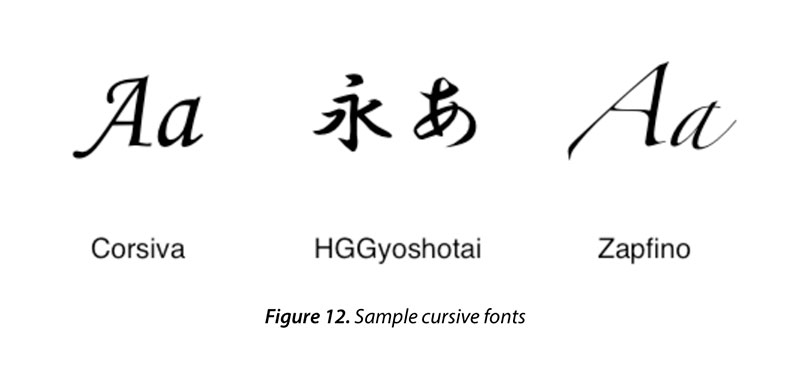
The current W3C Fonts Module editor’s draft has no mapping for “Kai—cursive”
What changes can the Chinese layout requirements bring to the Web?
Let’s talk about the future. Once the Chinese layout requirements are complete, the W3C i18n group will review the technical details, compare them with existing CSS specifications, and produce a gap document identifying what needs to change. That way the problems current technology cannot solve can be addressed comprehensively.
For example, in CSS, specifying “font-family: serif;” automatically uses the system’s default Song (Ming) typeface, and “font-family: sans-serif;” points to a Hei typeface. But Kai, so common in Chinese, is ignored: to specify it you have to list every possible font. This is a big problem for how EPUB ebooks display across different devices and reading apps.
At last year’s W3C TPAC meeting I proposed making the generic family cursive default to Chinese Kai. But John Daggett, editor of CSS Fonts Module Level 3, did not accept it. With the Chinese layout requirements as a reference, the case could be made more persuasively.
Incidentally, John Daggett now lives in Japan, and in the new Fonts Module editor’s draft he has added a great deal of support for Japanese. I hope one day it will extend to Chinese too.
Next steps for the Chinese layout requirements
The Chinese Layout Task Force will handle not only Chinese characters but also layout specifications for Mongolian, Tibetan and other scripts (Mongolian should be the first specification for a script written vertically from left to right—apart from it, only Manchu remains). The main editing work will be finished by the end of 2016.
The Chinese layout requirements are currently at their first Editor’s Draft. Besides the Chinese version, it will also be translated into English and published alongside as the main document.
For now it contains only the structure of my first draft and the meticulous “interlinear annotation” section (that is, zhuyin and pinyin) written by Liang Hai and Ethan Chen; many sections and images remain to be filled in. If you would like to follow the discussion and progress of the project, you can subscribe to W3C’s zhreq mailing list. If you would like to contribute to the document or help translate it, you can contact Xiaoqian Wu of W3C Beihang.