The New Requirements for Chinese Text Layout: A Unified Structure and Future Possibilities
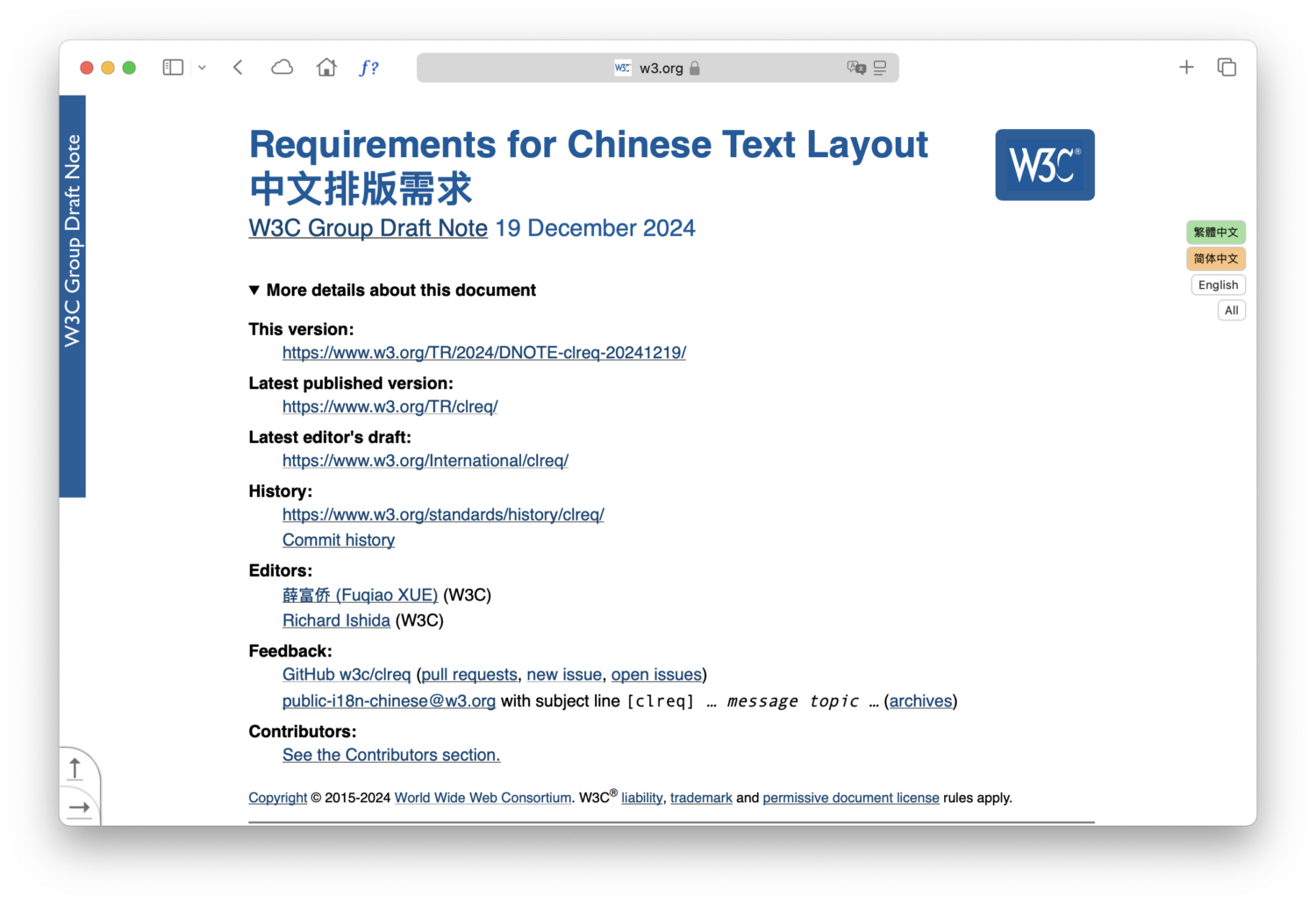
At the end of 2024, the World Wide Web Consortium (W3C) published a new version of the “Requirements for Chinese Text Layout” (CLReq). It is the first major restructuring of the document since its first draft was published in 2015. The new version shares the structure of W3C’s layout requirements documents for other languages and scripts (such as Arabic script and Mongolian), aiming to give developers, designers and editors of technical standards a more efficient and clearer reference. The change also strengthens the position of CLReq as part of a global set of layout standards.
Aligning with other documents: a unified global layout framework
One highlight of the new CLReq is that it is integrated into W3C’s Language Enablement (language enablement) framework. This is an overall framework for the layout requirements of every language and script, intended to ensure that typographic needs around the world can be built into Web technologies such as HTML, CSS and SVG, so that web pages and ebooks look and behave the way users everywhere expect.
At the heart of the framework is the language matrix (language matrix), which shows how well different languages are supported by Web technologies. Its columns represent the features the Web needs to support (such as writing modes, punctuation handling and text justification), and colours show the state of support for each language. Through the matrix, developers and standards makers can see clearly which features are missing or implemented, and plan improvements accordingly.
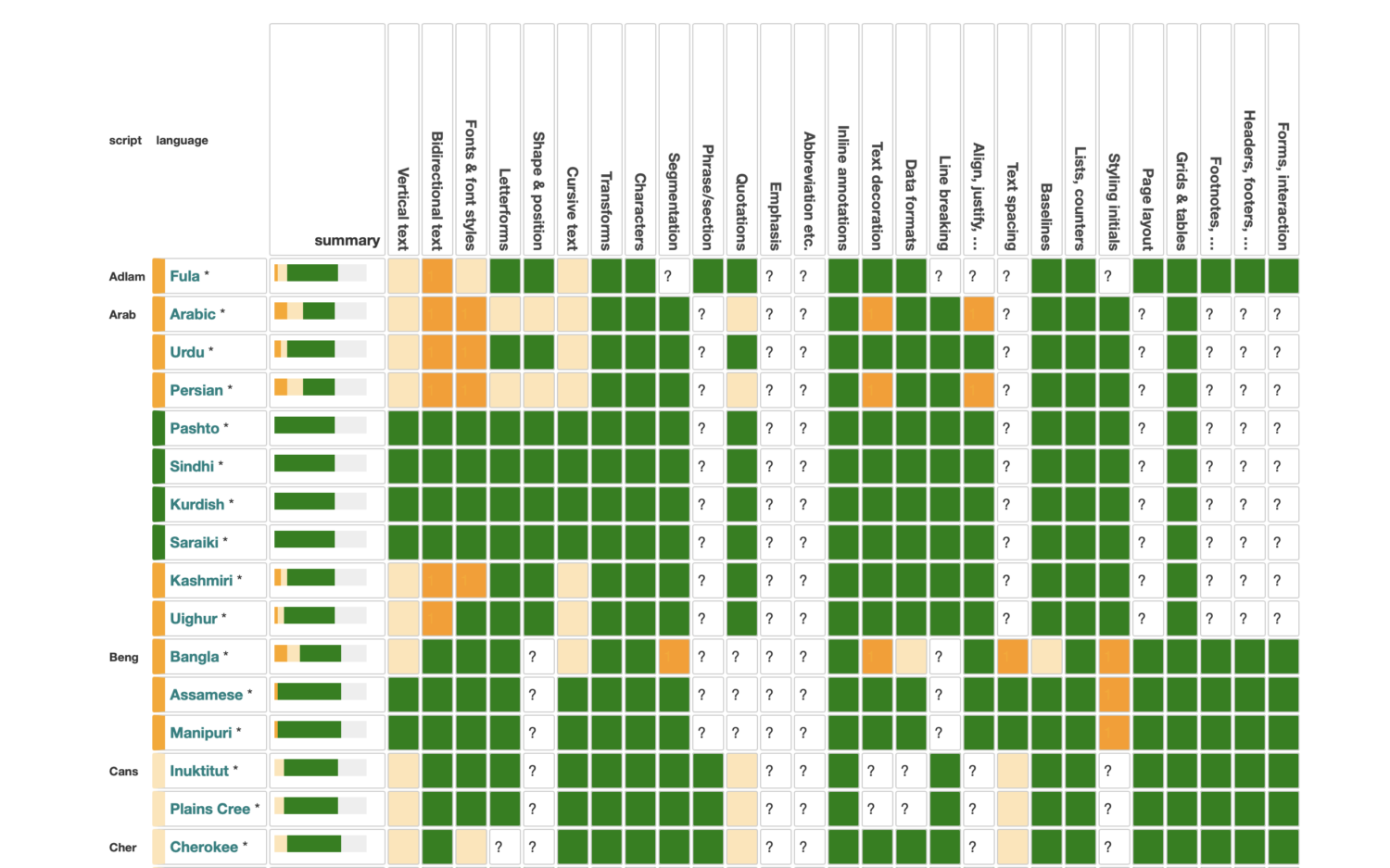
Engineers familiar with CSS standards and browser development can easily find the Chinese rules for a particular feature in the new document, making it easier to consult. Its links also connect to frameworks such as W3C’s Chinese language enablement resources (Chinese Script Resources), the Chinese gap analysis (Chinese Layout Gap Analysis), the language matrix, the script resource index and the typographic case index, giving readers who want to study multilingual layout in depth a complete reference system.
Building on the Language Enablement framework, W3C works closely with organisations such as the Unicode Consortium, type design firms and IETF to push forward the technical implementation of layout requirements—for example, the variation selector mechanism for Chinese punctuation at Unicode, and the new proposal on spacing between Chinese and Western text.
The CLReq tangram: assembling the logical puzzle of Chinese layout
In the new CLReq, the layout requirements have been reorganised into seven chapters—like seven pieces of a puzzle that together build the logical system of Chinese layout. The seven chapters are:
-
-
- Text direction: Text direction is one of the basic properties of Chinese layout, covering two main modes, horizontal and vertical. This chapter covers the basic rules of horizontal and vertical text, discusses the characteristics of Chinese layout in different writing modes, and how to effectively support mixed text of Chinese, Western scripts and languages written in Arabic script in multilingual environments.
- Glyph shaping and positioning: This chapter describes the four typefaces most commonly used in Chinese layout—Song, Kai, Hei and Fangsong.
- Typographic units: This chapter mainly concerns encoding; content on how text is segmented into characters, words and so on will be added in future.
- Punctuation and inline features: Handling punctuation is one of the most complex and most regionally varied parts of Chinese layout. The document not only continues to explore differences in punctuation position between regions using Simplified and Traditional Chinese (such as bottom-left punctuation in horizontal Simplified Chinese versus centred punctuation in Traditional Chinese), but also specifies the code points of punctuation marks. The implementation details of pinyin and zhuyin are also described in this chapter.
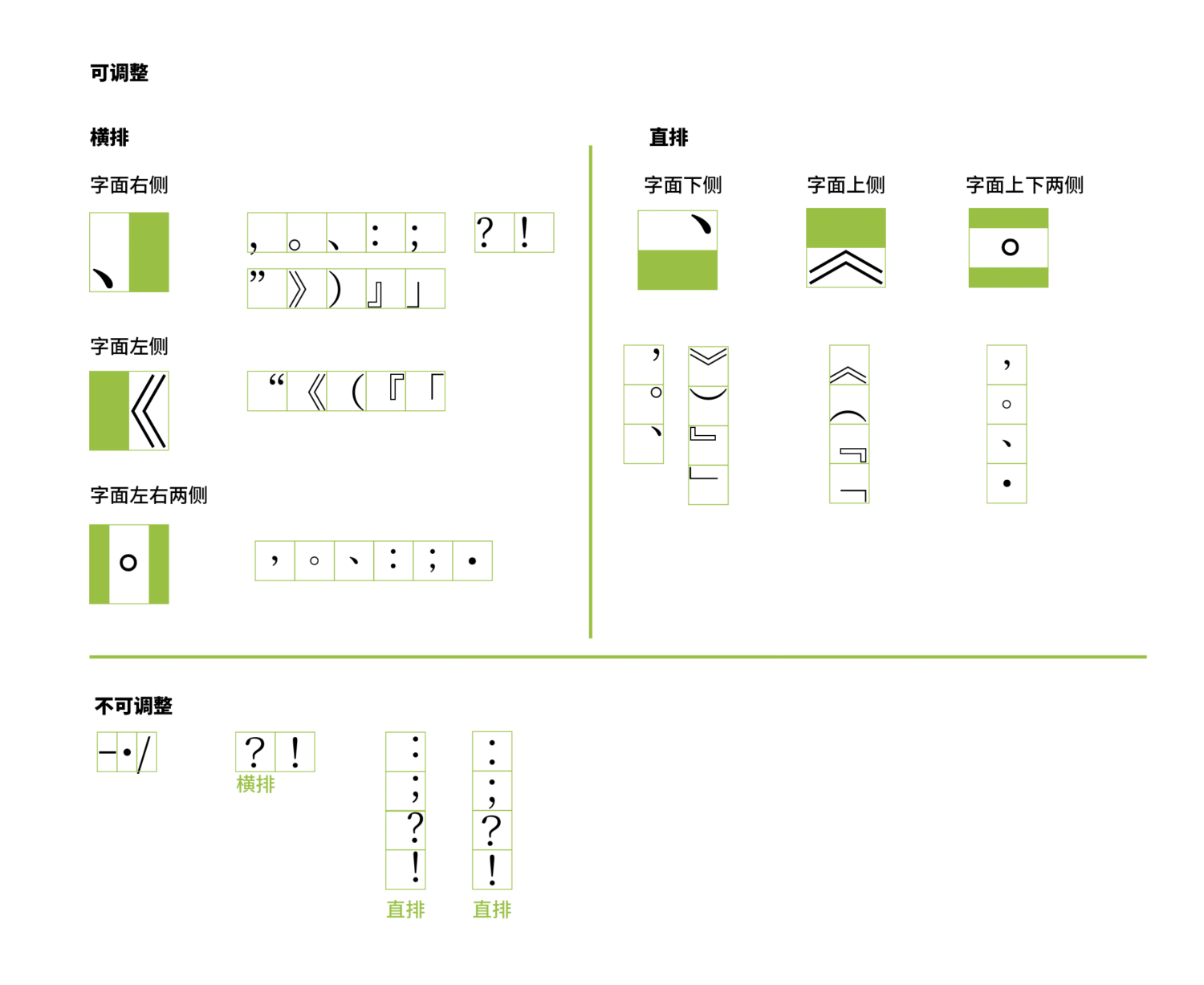
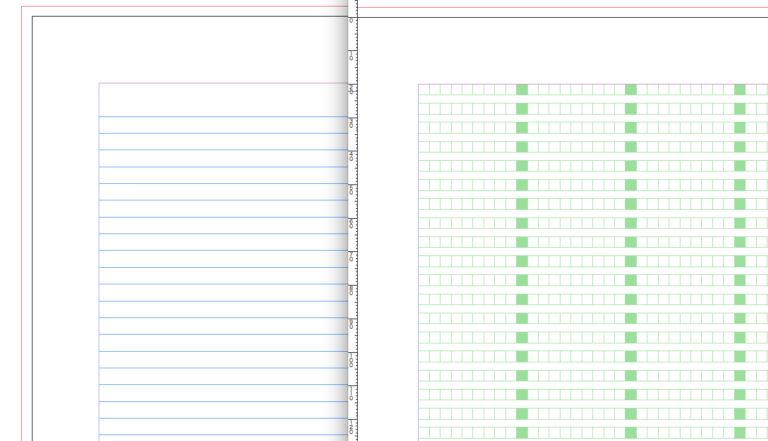
- Line and paragraph layout: How can the beauty of traditional typesetting be achieved in digital environments such as web pages and ebooks? This chapter focuses on details such as line-start and line-end prohibition, first-line indentation, inline adjustment, punctuation width adjustment and mixed Chinese–Western text, using illustrations to help developers understand more intuitively how these features can be implemented in CSS and browsers.
- Page and book layout: This chapter is aimed mainly at ebook publishing, discussing page design, handling of widows and orphans, and headings (including page breaks). More content is still being written, in the hope of helping developers of ebook readers.
- Forms and user interaction: Form design is often seen as purely functional, but in practice the layout of forms directly affects user experience. In the new version we will add a chapter on Chinese layout in form controls, discussing in detail the layout of human–computer interaction controls—marking the extension of CLReq from traditional layout requirements into modern interaction design.
Writing the future of Chinese layout together
CLReq could not have been completed without the hard work of many volunteers. From the earliest draft translations to today’s structural revision, every member of the editorial team has contributed. Special thanks to all the editors and volunteers who have given their wisdom and effort to CLReq: Eric Liu, Qian Zhengyu, Ethan Chen, Bobby Tung, Chen Huijing, Chen Yongcong, Richard Ishida… It is thanks to their efforts that the document keeps improving.
The release of the new CLReq is only a beginning; improving the document and truly implementing Chinese layout requirements still needs more people to take part. We invite anyone interested in Chinese layout, type design and digital publishing to join the work on CLReq—whether by contributing regional layout rules or examples, making suggestions or taking part in discussion, every effort will advance the heritage and development of Chinese typographic culture.
Readers interested in taking part can visit the CLReq GitHub page or write to the author at xfq [at] w3.org.
Related articles
- Starting with the Requirements for Chinese Text Layout
- Doing Web Typography with a Print Mindset
- Next Steps for Japanese Support
- Looking Back at the Requirements for Chinese Text Layout
- The Peacock Project: Approaches to Chinese Typography
Related podcast episodes
- TypeChat 007: “Wanted”—contributors to Chinese typography
- TypeChat 054: ㄨㄛˇ ㄞˋ ㄓㄨˋ ㄧㄣ (I love zhuyin)
- TypeChat 143: “Why are Chinese ebooks still so bad?”
- TypeChat 144: A decade of small steps in CSS Chinese layout
- TypeChat 186: Progress on the Requirements for Chinese Text Layout
- Kernel Panic 016: And Now for Something Completely Different
-